Page 04 · 展品分揀 Item Sorting
Hideki Yukawa's Humanistic World
本區共收錄 28 件書法、畫作、手稿、信札、和歌與彩箋等作品,分為三個主題子分類。點選任一「紀念郵票卡」進入該作品的沉浸式詳細頁。
This section presents 28 works spanning calligraphy, painting, manuscripts, letters, and waka poetry, grouped into three thematic subsections. Select any commemorative stamp card to open the artifact's immersive detail page.
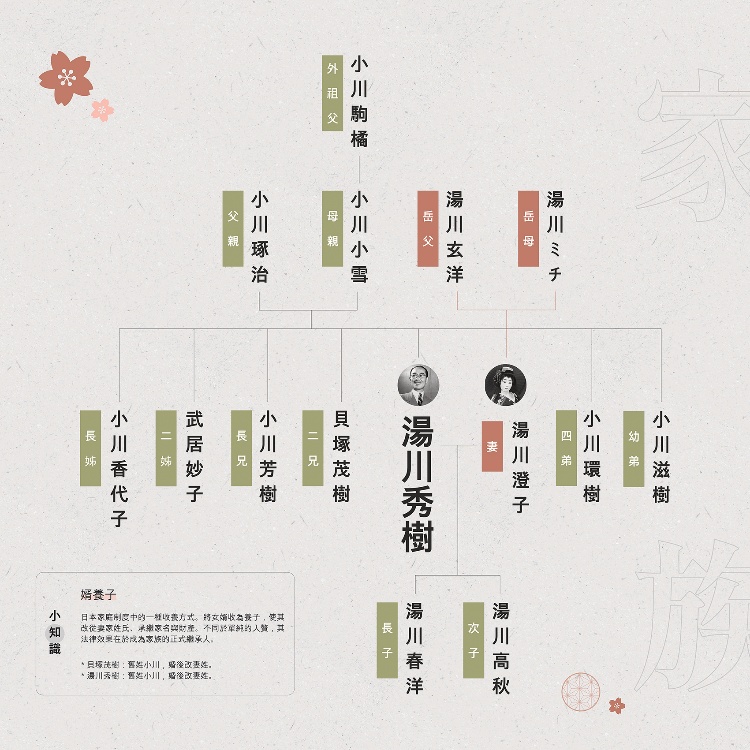
湯川秀樹的父親小川琢治(1870-1941)是京都帝國大學地質學教授,他學識淵博,兼通文史,與歷史學者內藤湖南(1866-1934)及哲學家西田幾多郎(1870-1945)交誼深厚;母親小川小雪曾就讀東洋英和女校,是當時少數通曉英語的女性;書法老師山本竟山則為知名書法大家。這樣兼容理學與文學的家庭氛圍,孕育出在各領域皆有所建樹的學者──長子芳樹(1902-1959)是冶金學者;次子茂樹(1904-1987)為中國史學者;三子秀樹為理論物理學家;四子環樹(1910-1993)則專研中國文學。
此外,物理學家中谷宇吉郎(1900-1962)則是與湯川秀樹相知最深的友人之一,其以雪花的研究聞名,也擅長散文寫作。本單元展出湯川秀樹家族與周圍學友的墨跡,呈現二十世紀前半日本知識圈兼容理性與感性的文化樣貌。
Hideki Yukawa's father, Takuji Ogawa (1870–1941), was a geology professor at Kyoto Imperial University. An erudite scholar versed in both the sciences and the humanities, he was a close friend of the distinguished historian and philosopher Konan Naitō (1866–1934). Yukawa's mother, Koyuki Ogawa, educated at Toyo Eiwa Jogakuin, was among the few women of her time fluent in English. By harmonizing scientific inquiry with literary cultivation, this unique family nurtured four accomplished brothers: the metallurgist Yoshiki (1902–1959), the historian Shigeki (1904–1987), the theoretical physicist Hideki, and the Sinologist Tamaki (1910–1993).
Among Yukawa's closest intellectual companions was the physicist Ukichiro Nakaya (1900–1962), celebrated for both his pioneering snow crystal research and his elegant essays. Through the handwritten works of Yukawa's family and scholarly circle, this section offers a glimpse into a cultural milieu where rational inquiry and literary sensibility deeply intertwined.
湯川秀樹對「文學」與「科學」之間的相通性,懷有深厚的興趣和體悟。從他書寫的和歌與繪畫作品中,可見他以物理學家的思維與觀察視角,轉化為獨具風格的藝術語言。在他的筆下,詩歌不僅為描寫生命存在的無常與虛幻,也觸及了物質、時間與能量消逝的本質;於繪畫之中,則融匯道家思想,追求「天人合一」的精神境界,透過乾、枯、濃、淡的筆墨變化,呈現自然萬象的律動與生機。他的詩畫創作不僅為抒發感性情懷,更融入對宇宙秩序與存在原理的理性思索。
Yukawa nurtured a deep fascination with the resonances between literature and science, perceiving in both a shared pursuit of truth and beauty. His waka poetry and paintings revealed how the mind of a physicist could transform observation and contemplation into a distinctive artistic language. In his poetry, he reflected not only on the impermanence and ephemerality of existence, but also on the very nature of matter, time, and the fading of energy. In his paintings, infused with Daoist thought and the ideal of harmony between humanity and the cosmos, variations of dry, fading, rich, and light brushwork evoked the rhythms and vitality of the natural world.
Yukawa's poetic and artistic creations were not merely expressions of sentiment; they also embodied his rational inquiry into the underlying order of the universe and the principles of existence.
歷經二戰的震撼與反思後,湯川秀樹的重心逐漸轉向人類責任與世界和平的課題。1946年,世界各地的科學家與知識分子因憂慮國際間缺乏有效抑止戰爭的力量,發起「世界聯邦運動」。湯川秀樹對此理念深表認同並積極參與其中。翌年,為促進建立「世界政府」而設立的「世界聯邦主義者運動組織」正式成立,他與妻子湯川澄子(湯川スミ)長年皆是成員,其中澄子更曾出任世界聯邦運動協會會長。
戰後的湯川秀樹不僅以物理學家的身分思索科學與人類的關係,也在書畫與詩文中寄託對世界和平的期許。他多次題寫「世界は一つ」(世界一體)、「平和」(和平)等語。對和平理念的追求,貫穿了他晚年的思想與創作。
In the aftermath of World War II—with its profound shock and moral reckoning—Yukawa's attention turned increasingly toward the ethical responsibilities of humankind and the pursuit of a lasting peace. In 1946, scientists and intellectuals worldwide initiated the World Federalist Movement out of concern that the international community lacked effective mechanisms to prevent war. Yukawa strongly identified with its ideals and became actively involved. The following year, the World Movement for World Federal Government was formally organized to advance the creation of a "world government." Both Yukawa and his wife, Sumiko (Sumi) Yukawa, remained devoted members for many years; Sumi would later serve as president of the movement's Japan chapter.
In the decades that followed, Yukawa reflected not only as a physicist but also as a humanist on the relationship between scientific progress and the future of humanity. In his calligraphy and poetic inscriptions, he often wrote phrases such as "The world is one" and "Peace," revealing how the pursuit of peace became a thread running through his later thought and creative practice.
Takuji Ogawa (1870–1941)
小川琢治(1870-1941)是湯川秀樹的生父,本姓淺井,是儒士淺井篤的次子,後為紀州藩士小川駒橘(1844-1922)的婿養子。他自幼博覽漢籍,入學前即在生父的私塾研讀四書五經。畢業於東京帝國大學地質學科,後進入地質調查所。1908年起任京都帝國大學地理學講座教授,是日本近代地理學與地質學的重要推動者之一。
本次展出其書作兩件,其一錄蘇軾(1037-1101)尺牘語句,另一件為自作漢詩,末題其作於北京途上。小川琢治曾多次赴中國考察研究,對日本近代的中國地理與地質學發展均有重要貢獻。
圖片來源:維基百科
Takuji Ogawa (1870–1941) was the birth father of Hideki Yukawa. Born into the Asai family as the second son of the Confucian scholar Asai Atsushi, he later became the adopted son-in-law of Komakitsu Ogawa (1844–1922), a retainer of the Kishu Domain. From an early age, Ogawa was deeply immersed in the study of classical Chinese texts, reading the Four Books and Five Classics at his father's private academy even before entering formal schooling.
He graduated from the Department of Geology at Tokyo Imperial University and subsequently joined the Geological Survey of Japan. In 1908, he was appointed professor of geography at Kyoto Imperial University, where he played a pivotal role in the development of modern geography and geology in Japan.
Two calligraphic works by Takuji Ogawa are presented here. One transcribes a passage from a letter by Su Shi (1037–1101). The other is a self-composed Chinese poem, inscribed with a note indicating it was written while traveling to Beijing. Ogawa undertook multiple research journeys to China, making significant contributions to the development of modern Japanese studies of Chinese geography and geology.
Image source: Wikipedia
Shigeki Kaizuka (1904–1987)
貝塚茂樹(1904-1987)是湯川秀樹的次兄。原姓小川,後成為三重縣桑名市長貝塚榮之助(1882-1947)的婿養子。自京都帝國大學史學科畢業後,投入東洋史與甲骨文研究,擔任東方文化學院京都研究所研究員;1949年後轉任京都大學人文科學研究所。
本作封面標註「生原稿」,可知此為《孫文》一書正式付梓前的原初稿件。開首記載出版資訊與作者略歷,從略歷中可見茂樹已獲文化勲章。茂樹的著作等身,亦曾撰寫多部孫文相關專書,包括《孫文と日本》與《孫文と毛沢東》。
Shigeki Kaizuka (1904–1987) was Hideki Yukawa's second elder brother. Born into the Ogawa family, he later became the adopted son-in-law of Einosuke Kaizuka (1882–1947), mayor of Kuwana City in Mie Prefecture. After graduating from the Department of History at Kyoto Imperial University, he devoted himself to the study of East Asian history and oracle bone inscriptions, serving as a researcher at the Institute of Oriental Studies. From 1949 onward, he was affiliated with the Institute for Research in Humanities at Kyoto University.
The cover of this manuscript is marked "original draft," indicating that it predates formal publication of Sun Yat-sen. The opening pages record publication details and a brief biography of the author, noting that Shigeki had already received the Order of Culture. A prolific scholar, Shigeki authored several major studies on Sun Yat-sen, including Sun Yat-sen and Japan and Sun Yat-sen and Mao Zedong.
Tamaki Ogawa (1910–1993)
小川環樹(1910-1993)是湯川秀樹的四弟。秀樹曾回憶,環樹自幼酷愛閱讀且記憶力驚人,甚至能記住家中所有藏書的位置,連父親都深感驚嘆。環樹後來成為近代日本重要的中國古典小說與詩詞研究者,畢業於京都帝國大學文學部,後任教於東北帝國大學(戰後為東北大學)與京都大學。
展出的兩件明信片寫於1943年,當時環樹在東北帝大任教,致信予京都的中田勇次郎(1905-1998),感謝其贈書,並因校內需求,請求再寄一冊。信中並提及日本東北春遲的氣候。
Tamaki Ogawa (1910–1993) was Hideki Yukawa's younger brother. Hideki later recalled that Tamaki developed an intense love of reading from an early age and possessed an extraordinary memory—so remarkable that he could recall the location of every book in the family's library, to the amazement even of their father. Tamaki went on to become a leading scholar of classical Chinese fiction and poetry in Japan. He graduated from the Faculty of Letters at Kyoto Imperial University and later taught at Tohoku Imperial University (later Tohoku University) and Kyoto University.
The two postcards on view were written in 1943, when Tamaki was teaching at Tohoku Imperial University. Addressed to Yujiro Nakata (1905–1998) in Kyoto, they express his gratitude for the gift of a book and include a request for an additional copy to meet institutional needs. He also remarks on the late arrival of spring in northeastern Japan.
Ukichiro Nakaya (1900–1962)
中谷宇吉郎(1900-1962)是湯川秀樹的摯友,也是日本雪與低溫研究的開拓者。畢業後長期任職於北海道帝國大學(戰後為北海道大學)。自1932年起專注雪的研究,其實驗室揭示雪結晶的形成機制,並率先成功製造出人造雪。
宇吉郎與秀樹自1938年結識,情誼在1940年秀樹赴北大授課期間更深厚。本作落款於1940年,推測是他們在北海道相聚時所留下。畫中以淡墨呈現雪的輕盈與透明,並以濃墨勾勒冰晶之銳利輪廓。
圖片來源:維基百科
Ukichiro Nakaya (1900–1962) was a close friend of Hideki Yukawa and a pioneer of snow and low-temperature research in Japan. He spent most of his academic career at Hokkaido Imperial University (renamed Hokkaido University after the war). From 1932 onward, he devoted himself to the study of snow, elucidating the mechanisms of snow-crystal formation and successfully producing artificial snow for the first time.
Ukichiro and Hideki first met in 1938, and their friendship deepened in 1940 when Hideki traveled to Hokkaido to teach. Inscribed with the date 1940, this work is thought to have been created during their time together in Hokkaido. Rendered in pale ink, the snow appears light and translucent, while darker strokes define the sharp contours of ice crystals.
Image source: Wikipedia
Kyouzan Yamamoto (1863–1934)
山本由定(1863-1934),又名繇定,號岐山、竟山,以號行,是湯川秀樹一家手足的書法教師。早年師事日下部鳴鶴(1838-1922)等名家,並在日下部的引介下向楊守敬(1839-1915)學習。
秀樹自學齡前便在山本竟山門下習字,由「永字八法」啟蒙,逐步進入楷、行、草諸體,至第三高等學校時方始學習隸書。從秀樹後來的回憶可知,他之所以能自信落筆、書以贈人,正是因為受山本竟山訓誨建立了扎實功底,使書寫成為他優雅表達心意的方式。
本作可見其融會日下部與楊守敬書風之面貌。
Kyouzan Yamamoto (1863–1934) served as the calligraphy instructor for Hideki Yukawa and his siblings. Trained early on under leading calligraphers such as Meikaku Kusakabe (1838–1922), Yamamoto was later introduced by Kusakabe to the eminent Qing scholar Yang Shoujing (1839–1915).
Hideki began studying calligraphy under Yamamoto even before reaching school age, starting with the foundational Eight Principles of the Yong Character and gradually advancing through regular, running, and cursive scripts; it was not until his years at the Third Higher School that he first encountered clerical script. In later recollections, Hideki attributed his confidence in writing and in presenting calligraphy to others to the rigorous training he received from Yamamoto, which provided him with a solid foundation and allowed calligraphy to become a graceful means of personal expression.
The brushwork of this work reflects the style he developed through the synthesis of Kusakabe's and Yang's calligraphic traditions.
Kitaro Nishida (1870–1945)
西田幾多郎(1870-1945),號寸心居士,京都帝大文學部教授。以禪學研究著稱,其思想融合佛教與近代西方哲學,開創日本獨具體系的哲學概念。湯川秀樹早年曾研讀其名著《善的研究》,大學在學時亦曾旁聽他的課程。
此作寫禪詩一句,描寫萬籟俱寂之夜,一聲虎嘯驟然響起,詩人循聲望去,只見山月高懸。
圖片來源:維基百科
Kitaro Nishida (1870–1945), also known as Sunshin Koji, was a professor at Kyoto Imperial University and a leading figure in modern Japanese philosophy. Drawing on Zen thought, he developed a philosophical system that brought Buddhism into dialogue with modern Western philosophy. Hideki Yukawa encountered Nishida's thought early on, reading An Inquiry into the Good and attending his lectures as a student.
This work records a line from a Zen poem describing a silent night suddenly broken by a tiger's roar, as the poet looks up to see the moon high above the mountains.
Image source: Wikipedia
Konan Naitō (1866–1934)
內藤湖南(1866-1934),本名虎次郎,京都帝國大學文學部教授,是日本東洋史研究的奠基者之一,曾提出「文化中心移動說」與「唐宋變革論」。1908年,湯川秀樹之父小川琢治轉任京大文學部,因而和同在京大的內藤湖南建立深厚的交誼。秀樹雖未曾與內藤謀面,但父親與內藤的密切學術關係,使秀樹對內藤的學識與人格深抱敬意。當內藤聞悉秀樹立志從事物理研究時,曾予以高度讚許,此舉對秀樹頗具激勵作用。
「迥」為高遠,「合」為交會契合;「天機」多指天地運行之奧理,合觀後或可寓為超然境界,契合天地運行之意。古典詩文與畫論中亦見相近語彙,如唐人齊己(863-937)〈中春感興〉有「道合天機」之句;歷代論王維畫亦稱「絕跡天機」、「迥出天機」,以言其筆墨契合自然。
圖片來源:維基百科
Konan Naitō (1866–1934), whose given name was Torajirō, was a professor in the Faculty of Letters at Kyoto Imperial University and one of the founding figures of Japanese studies of East Asian history. He proposed theories such as the shifting of cultural centers and the transformation between the Tang and Song dynasties. In 1908, Hideki Yukawa's father, Takuji Ogawa, transferred to Kyoto Imperial University, where he formed a close scholarly friendship with Naitō. Although Hideki never met Naitō in person, the deep academic bond between his father and Naitō fostered in him a lasting respect for Naitō's scholarship and character. When Naitō learned of Hideki's decision to pursue physics, he offered high praise, which proved a source of encouragement to the young Hideki.
"Jiong" (迥) denotes loftiness or transcendence, while "he" (合) means convergence or alignment. "Tianji" (天機) commonly refers to the underlying principles governing the cosmos. Taken together, the phrase may be understood as the cyclical unfolding of all things in accordance with the workings of nature. Comparable expressions appear in classical poetry and painting theory: the Tang-dynasty monk-poet Qi Ji (863–937) wrote "dao he tianji" (道合天機, "the Way accords with the cosmic principle"), and later art criticism on Wang Wei described his paintings as "jueji tianji" (絕跡天機) and "jiongchu tianji" (迥出天機), suggesting that his brushwork achieves a state of naturalness beyond visible artifice.
Image source: Wikipedia
Album of Calligraphy and Painting by the Ogawa, Yukawa, and Nakaya Families
此冊頁原為湯川秀樹珍藏的小冊,記錄其與親友的交誼記事,內容包括時間、地點與題記,並可見他們以漢詩、和歌、繪畫與書法互相唱和。留下紀錄的人物主要屬於以下三個家族:
一、小川家族:小川琢治(父)、小川芳樹(長兄)、貝塚茂樹(原姓小川,二兄)、小川環樹(四弟)、武居妙子(原姓小川,二姊)。
二、湯川家族:湯川蜻洋(1891-卒年待考,秀樹之妻兄,醫師)、山本京子(蜻洋之妻,大審院檢事)、湯川淑子(蜻洋之長女)。
三、中谷家族:中谷宇吉郎(物理學者)、中谷靜子(原姓寺垣,宇吉郎再婚之妻)、中谷冬子(宇吉郎之妹)。
此外,亦有熊谷寛夫(1911–1977,原姓青木,物理學者)等學者於冊中留跡。
This album was originally a small notebook cherished by Hideki Yukawa, recording moments of exchange with family members and close friends. Entries note dates, locations, and brief inscriptions, and reveal how the participants responded to one another through Chinese poetry, waka, painting, and calligraphy. The individuals whose traces appear in the album belong primarily to the following three families:
i. The Ogawa family: Takuji Ogawa (father); Yoshiki Ogawa (elder brother); Shigeki Kaizuka (second elder brother; originally surnamed Ogawa); Tamaki Ogawa (fourth younger brother); and Taeko Ogawa (second elder sister).
ii. The Yukawa family: Seiyō Yukawa (b. 1891; Hideki Yukawa's brother-in-law and a physician); Kyōko Yamamoto (wife of Seiyō Yukawa, who served as a prosecutor at the Great Court of Cassation); and Toshiko Yukawa (eldest daughter of Seiyō Yukawa).
iii. The Nakaya family: Ukichiro Nakaya (physicist); Shizuko Nakaya (née Teragaki, Nakaya's second wife); and Fuyuko Nakaya (Nakaya's younger sister).
In addition, scholars such as Hiroo Kumagai (1911–1977; originally surnamed Aoki), a physicist, also left records in the album.